

Before You Buy: FOX 2.0 vs 2.5 vs Elite DSC vs 3.2 Live Valve on the 2024-2026 Ford Ranger
Here's one we hear almost every day now that the new Ranger has been out for a couple of years. "I want FOX on my 2024 Ranger. I pulled up your page and there are 24 FOX listings. There's a 2.0, a 2.5, a 2.5 HD, an Elite, an Elite HD, a Raptor one, and every one of them comes in a front and a rear with two different lift heights. Which one do I actually buy?"
It's a fair question. FOX's Ranger lineup isn't complicated once you see how it's built, but nobody explains it on the product pages. Twenty-four listings really boils down to five setups, and the rest is just front versus rear, single versus pair, and how much lift your rear end has. So here's how we'd walk you through it at the counter: what each tier is, who it's for, what a full truck costs, and which rear shock goes with your build.
Quick note before we start. Everything here is for the 2024-2026 Ranger, the new generation. None of these fit a 2019-2023 Ranger, and nothing from the old truck fits the new one. If you've got the older truck, our post on upgrading front coilovers on the 2019-2023 Ranger is the one you want.
The Five Setups
Strip away the duplicate listings and here's what FOX actually makes for the new Ranger:
- FOX 2.0 Performance Series IFP. The entry point. Adjustable front coilovers and matching rear shocks for 4WD XL, XLT and Lariat trucks.
- FOX 2.5 Performance Series IFP. Same idea, bigger shock. Same lift range as the 2.0.
- FOX 2.5 Performance Series IFP HD. The 2.5 tuned for a heavier truck. Same price as the standard 2.5.
- FOX 2.5 Performance Elite DSC (standard and HD). Reservoir shocks with a dual speed compression adjuster. This is the top of the line for the non-Raptor trucks.
- FOX 3.2 Factory Race Series Live Valve. Ranger Raptor only. A bigger replacement for the Raptor's factory FOX shocks.
Every one of the non-Raptor setups is a front coilover plus a rear shock. Up front, you're replacing the factory strut assembly with a complete FOX coilover that has a threaded body, so you set the ride height yourself. Out back the Ranger rides on leaf springs, so the rear is a straight shock swap, and the rear shock you pick depends on whether the back of the truck is staying at stock height or getting lifted too. We'll get to that.

What IFP, Reservoir and DSC Actually Mean
Three terms do most of the sorting in this lineup, so it's worth thirty seconds on each.
IFP stands for internal floating piston. Every shock needs somewhere for the oil to go when the shaft pushes in, and in an IFP shock that space is a pocket of pressurized nitrogen inside the shock body, kept separate from the oil by a floating piston. It's a clean, compact design and it's what the 2.0 and 2.5 Performance Series use. Nothing hanging off the side, nothing to mount, nothing to adjust.
Reservoir means the shock has a second chamber outside the main body that holds extra oil and the nitrogen charge. More oil means more capacity to soak up heat before the damping starts to fade, and it frees up room inside the main body for more shaft travel. The Elite DSC shocks are reservoir shocks.
DSC is FOX's Dual Speed Compression adjuster, and it lives on that reservoir. It gives you two separate dials. Low speed compression controls the slow stuff: body roll in a corner, nose dive under braking, how the truck sits when you load the bed. High speed compression controls the fast stuff: potholes, washboard, a rock you hit harder than you meant to. Being able to firm up one without touching the other is the whole point of the Elite.
And 2.0 versus 2.5 is the diameter of the shock body in inches. The bigger body holds a bigger piston and more oil. On the street both feel like a big step up from stock. Where you feel the 2.5 is on a long, rough road where the 2.0 would start to heat up and get a little floaty, and on hard hits where the bigger piston controls the wheel better.
The Lineup Side by Side
| Body | Design | Damping Adjustment | Front Lift | Rear Options | Fits | |
|---|---|---|---|---|---|---|
| 2.0 Performance IFP | 2.0" | IFP | None (ride height only) | 0-3" | 0-1" or 1.5-2.5" | 4WD XL, XLT, Lariat |
| 2.5 Performance IFP | 2.5" | IFP | None (ride height only) | 0-3" | 0-1" or 1.5-2.5" | 4WD XL, XLT, Lariat |
| 2.5 Performance IFP HD | 2.5" | IFP, heavy duty tune | None (ride height only) | 0-3" | 1.5-2.5" only | 4WD XL, XLT, Lariat |
| 2.5 Elite DSC | 2.5" | Reservoir | Low and high speed compression | 1-3" | 0-1" or 1.5-2.5" | 4WD XL, XLT, Lariat |
| 2.5 Elite DSC HD | 2.5" | Reservoir, heavy duty tune | Low and high speed compression | 1.5-3" | 1.5-2.5" only | 4WD XL, XLT, Lariat |
| 3.2 Live Valve | 3.2" | Internal bypass, reservoir | Electronic, automatic | 0-2" | 0-1" (rear coilover) | Ranger Raptor only |
FOX 2.0 Performance IFP: The Daily Driver Setup
The 2.0 is where most Ranger owners should start, and it's where a lot of them should stop. You get a full adjustable front coilover with 0 to 3 inches of lift, which covers everything from "just take the rake out" to a good stout front lift, plus FOX rear shocks valved for the new ride height. On the road it feels planted in a way the factory shocks don't. The nose doesn't bob over expansion joints, the truck settles faster after a dip, and it stops wallowing in the corners.
What it doesn't have is a lot of oil. If your idea of off-roading is a gravel road to the deer lease, a trail with some ruts in it, or pulling a boat to the lake on weekends, the 2.0 does that all day long and you'll never feel it run out of breath. If you spend an hour at speed on washboard, that's where a 2.0 starts to warm up and lose a little control, and it's where the 2.5 earns its money.
Cost: $1,259.90 for the front pair, $459.90 for a rear pair, or the FOX 2.0 Adjustable Suspension Package at $1,719.80, which puts the matched front coilovers and rears in one cart item. It's the setup we point most towing guys toward too, because the Ranger's rear leaf springs carry the load and the job of the shock back there is control, which the 2.0 handles fine.
Who it's for: daily drivers, light trail use, towing, and anyone who wants the truck level on a set of 33s with a ride that's better than stock without spending 2.5 money.
FOX 2.5 Performance IFP: The Sweet Spot
The 2.5 IFP is the same layout as the 2.0, same 0 to 3 inches of front lift, same simple no-dials design, in a bigger shock. If we had to put one FOX setup on a new Ranger without knowing anything about the owner, this would be it.
The reason is the price gap. A full 2.5 IFP setup is $2,273.80 ($1,579.90 front pair, $693.90 rear pair). That's $554 more than the 2.0 for a shock with a bigger piston and more oil, which is a lot of hardware for the money. You'll notice it most on rough dirt at speed and on the big hits, where the 2.5 stays composed and keeps the tires on the ground. On pavement the difference is smaller, but the 2.5 feels a little more buttoned down.
Who it's for: the guy who actually goes off-road a few times a month, drives forest roads and ranch roads at a decent clip, or just knows he's going to keep the truck a long time and wants the better shock once. If you're torn between the 2.0 and the 2.5, and the $554 doesn't hurt, get the 2.5.
Standard Tune vs HD Tune: Same Price, Different Truck
This is the one that confuses people, because the HD and standard versions of the 2.5 cost exactly the same. The 2.5 IFP front pair is $1,579.90 either way. The 2.5 IFP rear pair is $693.90 either way. The Elite DSC front pair is $2,549.95 either way. So you're not paying for HD, you're choosing it.
FOX describes the HD tune as a heavy duty spec built to support trucks carrying more weight or driven more aggressively. In plain terms, it's valved for a heavier truck. That's a steel front bumper and a winch hanging off the nose, a set of sliders and skids, a rooftop tent and a fridge in the bed, or a camper shell that's always loaded.
Here's the honest version. If your Ranger is basically stock weight, the standard tune is the one you want. It's going to ride softer and better on a truck that weighs what Ford built it to weigh. If you've added a few hundred pounds of armor and gear, or you're about to, the HD is going to feel more controlled and won't wallow under that weight.
One catch worth knowing about. FOX only makes the HD rear shocks in the 1.5 to 2.5 inch rear lift length, both for the 2.5 IFP and the Elite. That makes sense, since most trucks heavy enough to need HD are also running some rear lift to carry the load. But if you've got a winch bumper up front and a stock height rear, you'll run the HD fronts with standard tune rears in the 0 to 1 inch length. That's a perfectly normal combination.
Same story on the Elite fronts. The Elite DSC HD front lift range is 1.5 to 3 inches, versus 1 to 3 inches on the standard Elite. It's built to hold up a heavier nose, so it doesn't go quite as low.
FOX 2.5 Elite DSC: When You Want to Tune It Yourself
The Elite is the top FOX setup for the XL, XLT and Lariat, and it's a real jump in hardware. You're getting reservoir shocks front and rear with the DSC adjuster on every corner, so you can set the truck up stiffer for a fast desert road, then soften it back up for the drive home.
The reservoir is the big upgrade. More oil and a cooler-running shock means the Elite keeps its damping on long, hard runs where even the 2.5 IFP will eventually start to fade. And the DSC adjuster lets you fix the things that bug you about your particular truck. If the front dives too much under braking with your bumper on, add a few clicks of low speed. If it's chattering over washboard, take some high speed out. You can't do any of that with an IFP shock.
It isn't cheap. A full Elite setup is $4,439.90: $2,549.95 for the front pair and $1,889.95 for the rear pair. That's $2,166.10 more than the 2.5 IFP. Most of that gap is the rear shocks. The Elite rear pair costs almost three times what the 2.5 IFP rear pair does.
That's why a lot of guys split it. They run the Elite DSC front coilovers with 2.5 IFP rear shocks, which comes to $3,243.85. You get the reservoir, the adjusters and the better front end where the independent suspension is doing most of the hard work, and you save about $1,200. The trade is that the rear can't be tuned to match the front, and on fast whoops it's the rear that kicks first. If you're going to drive it like that, buy the matched Elite rears. If you're mostly crawling trails and doing forest roads, the split setup is a smart way to spend the money.
Who it's for: overland builds, fast off-road driving, and owners who like dialing in their truck. If you don't think you'll ever turn the knobs, you're paying for something you won't use, and the 2.5 IFP is the better buy.
If the Elite is the setup you want and it's the price holding you up, Affirm financing is available at checkout on all of these.
FOX 3.2 Live Valve: Ranger Raptor Only
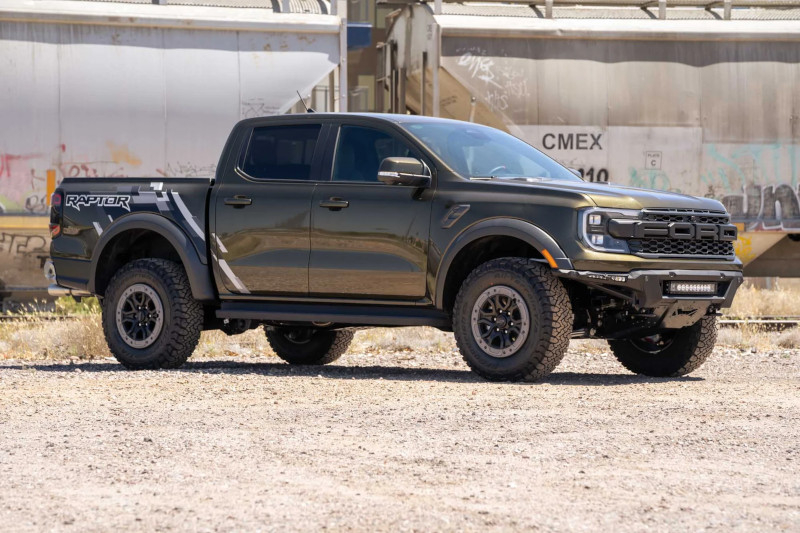
The Ranger Raptor is its own animal. It comes from Ford with FOX 2.5 Live Valve internal bypass shocks and a coil spring rear with a Watt's link instead of leaf springs, so none of the non-Raptor parts above will fit it. The upgrade for the Raptor is the FOX 3.2 Factory Race Series Live Valve: front coilovers at $3,999.95 a pair with 0 to 2 inches of lift, and rear coilovers at $3,799.95 a pair with 0 to 1 inch. A full set is $7,799.90.
Live Valve is FOX's electronically controlled damping. Sensors on the truck read what the suspension is doing, and the shocks change compression damping on the fly, faster than you could ever turn a dial. The 3.2 keeps that system and puts it in a much bigger internal bypass shock, with more oil and more piston to work with. The front 3.2s also give you a little lift to level the truck.
Here's what we tell Raptor owners straight. The factory FOX shocks on that truck are very good. If you drive it on the street with the occasional trail day, there's no reason to throw them away. The 3.2 makes sense if you're running the truck hard and fast in the desert, if you've added a lot of weight with a bumper, skids and gear, if your factory shocks are worn out and you're going to spend money on them anyway, or if you want the front leveled without giving up Live Valve.
What a Full Set Costs
| Setup | Front Pair | Rear Pair | Full Truck | Step Up From the Tier Below |
|---|---|---|---|---|
| 2.0 Performance IFP | $1,259.90 | $459.90 | $1,719.80 (also sold as a package) | Starting point |
| 2.5 Performance IFP or IFP HD | $1,579.90 | $693.90 | $2,273.80 | +$554.00 |
| Elite DSC front + 2.5 IFP rear | $2,549.95 | $693.90 | $3,243.85 | +$970.05 |
| 2.5 Elite DSC or Elite DSC HD | $2,549.95 | $1,889.95 | $4,439.90 | +$1,196.05 |
| 3.2 Live Valve (Raptor) | $3,999.95 | $3,799.95 | $7,799.90 | Raptor only |
Prices are what's on our site as this was written and can change. Don't forget to budget for an alignment after any front lift change.
Singles vs Pairs
You'll notice most of these come as a single and as a pair. A pair is just two singles, and the price per shock is the same either way ($789.95 for a single 2.5 IFP front coilover, $1,579.90 for the pair). The singles are there for one reason: replacing one shock. If you bent a coilover on a rock or one rear started leaking, you can replace that corner without buying both. For a new build, buy pairs and keep both sides matched.
Which Rear Shock Do I Need?
This is where people order the wrong part, so take a second with it. Every non-Raptor rear shock comes in a length for 0 to 1 inch of rear lift and one for 1.5 to 2.5 inches of rear lift (HD rears come only in the taller one). The front coilover lift doesn't decide this. What your rear axle is doing decides it.
The new Ranger sits with some factory rake, nose lower than the tail. Most guys use the adjustable front coilovers to bring the front up and level the truck, and leave the rear at stock height. That's a 0 to 1 inch rear shock. If you're adding rear lift too, with a block or an add-a-leaf, so the whole truck goes up for bigger tires, you need the 1.5 to 2.5 inch length. Run a short shock on a lifted rear and it tops out over every dip.
| What the rear of your truck is doing | Rear shock length | Options that fit |
|---|---|---|
| Stock height (front leveled only) | 0-1" | 2.0 IFP, 2.5 IFP, Elite DSC (standard tune only) |
| Up to 1" of rear lift | 0-1" | 2.0 IFP, 2.5 IFP, Elite DSC (standard tune only) |
| 1.5" to 2.5" of rear lift (block or add-a-leaf) | 1.5-2.5" | 2.0 IFP, 2.5 IFP, 2.5 IFP HD, Elite DSC, Elite DSC HD |
| More than 2.5" of rear lift | None of these | Call us, you're into a lift kit |
| Ranger Raptor | 0-1" | 3.2 Live Valve rear coilovers only |
If you're not sure what your truck has, look at the rear axle. If there's a lift block between the axle and the leaf spring, or an extra leaf in the pack that didn't come from Ford, it's lifted. If you bought the truck used and can't tell, give us a call and we'll help you figure it out.
Installing It Yourself
All of the non-Raptor setups are bolt-in, and most of our Ranger customers put them on in their own driveway. The FOX front coilovers come fully assembled with the spring already on, so you don't need a spring compressor. You're unbolting the factory strut assembly and bolting the FOX in its place. The rears are the easy part.
| Job | Who | Rough Time |
|---|---|---|
| Rear shocks (any of them) | You, in your driveway | 30-60 minutes for the pair |
| Front coilovers (2.0, 2.5, Elite) | You, with a jack, stands and basic hand tools | 2-4 hours for the pair |
| Set ride height | You, with a spanner wrench, before install | Part of the front install |
| Mount Elite reservoirs and set DSC | You | Add about an hour |
| Alignment | Any alignment shop | About an hour, after the front goes in |
| Raptor 3.2 Live Valve front and rear | A confident DIYer or a shop | Plan on a full day |
On lift: the FOX fronts go up to 3 inches, but the higher you go, the steeper your CV and ball joint angles get. Most guys level the truck somewhere around 2 inches and leave it. If you set it near the top of the range and can't get the alignment back in spec, aftermarket upper control arms are the fix.
So Which One?
If you drive your Ranger on the street, tow with it, and take it down a dirt road now and then, the FOX 2.0 package is the honest answer and it'll make you happy. If you're off-road a lot or you just want the better shock and the $554 isn't a problem, the 2.5 IFP is where we'd put most trucks. Pick HD if your truck carries real weight, standard if it doesn't. Step up to the Elite if you drive hard and fast and you'll actually use the adjusters, and think about the Elite front with 2.5 rears if the full set is more than you want to spend. And if you've got a Raptor, don't feel like you have to touch the factory shocks until you've outgrown them.
In the end, there's no wrong FOX on this truck. Every one of these is a big step up from what Ford put on it. It really comes down to how you drive, how much your truck weighs, and how much of that you want to tune yourself.
Shop FOX for Your 2024-2026 Ranger
- 2024-2026 Ford Ranger Suspension Upgrades
- 2024-2026 Ford Ranger Front Coilover Leveling Kits
- 2024-2026 Ford Ranger Rear Shocks
- FOX 2.0 IFP Rear Shocks for 1.5-2.5" Lift (Pair)
- All FOX Suspension
Frequently Asked Questions
Will FOX shocks from a 2019-2023 Ranger fit my 2024 Ranger?
No. The 2024 Ranger is a new generation with different suspension mounting and shock lengths. Only buy FOX parts listed for the 2024-2026 Ranger.
Do these FOX coilovers fit the Ranger Raptor?
Only the FOX 3.2 Live Valve front and rear coilovers fit the Ranger Raptor. The 2.0, 2.5 and Elite DSC setups are for 4WD XL, XLT and Lariat trucks. The Raptor has a different front end and a coil spring rear.
What's the difference between the FOX HD tune and the standard tune?
FOX valves the HD tune for trucks carrying extra weight or driven more aggressively, like a Ranger with a steel bumper, winch, armor or overland gear. The price is the same. Pick standard for a stock weight truck and HD for a heavy one. HD rear shocks only come in the 1.5 to 2.5 inch rear lift length.
Is the FOX 2.5 worth it over the 2.0 on a 2024 Ranger?
For most people who go off-road regularly, yes. A full 2.5 IFP setup costs $554 more than the 2.0 and gives you a bigger piston and more oil, which shows up as better control on rough roads and hard hits. For a truck that's mostly on pavement and towing, the 2.0 is plenty.
Which rear shock lift height do I need?
It depends on your rear axle, not the front coilovers. If the rear is at stock height and you only leveled the front, use the 0 to 1 inch rear shocks. If you added a block or add-a-leaf for 1.5 to 2.5 inches of rear lift, use the 1.5 to 2.5 inch rear shocks.
Can I mix FOX Elite fronts with 2.5 IFP rears?
Yes. Running Elite DSC front coilovers with 2.5 IFP rear shocks is a common way to save about $1,200 over a full Elite set. You give up adjustability in the rear, which matters most if you drive fast through whoops.
What do the DSC knobs on the FOX Elite do?
DSC is FOX's Dual Speed Compression adjuster. One dial sets low speed compression, which controls body roll, brake dive and how the truck handles weight. The other sets high speed compression, which controls how the shock reacts to sharp hits like potholes and washboard.
How much lift do the FOX front coilovers give a 2024 Ranger?
The 2.0 IFP, 2.5 IFP and 2.5 IFP HD are adjustable from 0 to 3 inches. The Elite DSC is 1 to 3 inches, and the Elite DSC HD is 1.5 to 3 inches. The Ranger Raptor 3.2 Live Valve fronts are 0 to 2 inches.
Can I install FOX coilovers on my Ranger myself?
Yes. The FOX front coilovers come assembled, so no spring compressor is needed. Plan on 2 to 4 hours for the fronts and under an hour for the rears with basic hand tools, then get an alignment.
Do I need an alignment after installing FOX coilovers?
Yes. Changing the front ride height changes your camber and toe. Get the truck aligned after the install, and again if you change the ride height later.
Still Can't Decide?
Give us a call. We'll ask you a couple of questions about how you drive and what your truck weighs, and point you at the right FOX setup.
Call 623-434-5277 Shop Ranger Suspension